Note
Go to the end to download the full example code.
Generate FM, AM and SFM stimuli
This demonstrates how to generate amplitude, frequency, and spectrotemporal modulated stimuli.
import matplotlib.pyplot as plt
import numpy as np

from psiaudio import stim
from psiaudio import util
from psiaudio.calibration import FlatCalibration


def plot_waveform(w, fs):
    figure, axes = plt.subplots(1, 3, figsize=(8, 8/3), constrained_layout=True)
    t = np.arange(len(w)) / fs
    axes[0].plot(t, w)
    axes[0].set_xlabel('Time (sec)')
    axes[0].set_ylabel(f'Amplitude (Pa)')
    axes[1].set_xlabel('Time (sec)')
    axes[1].set_ylabel('Frequency (kHz)')
    axes[1].specgram(w, Fs=fs);
    axes[1].set_yscale('octave', octaves=0.5)
    axes[1].axis(ymin=2e3, ymax=8e3, xmin=0, xmax=1)
    axes[2].plot(util.patodb((util.psd_df(w, fs=fs)).iloc[1:]))
    axes[2].set_xlabel('Frequency (kHz)')
    axes[2].set_ylabel('Amplitude (dB SPL)')
    axes[2].set_xscale('octave', octaves=0.5)
    axes[2].axis(ymin=0, xmin=2e3, xmax=8e3)
    return figure, axes
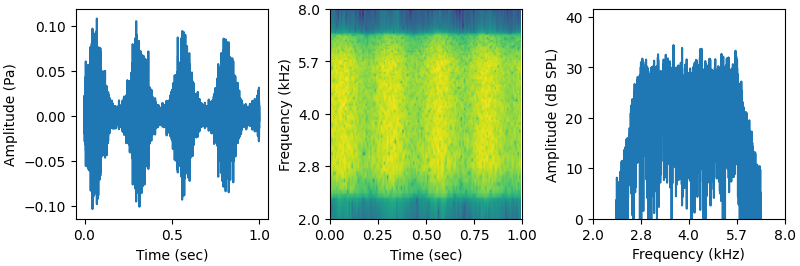
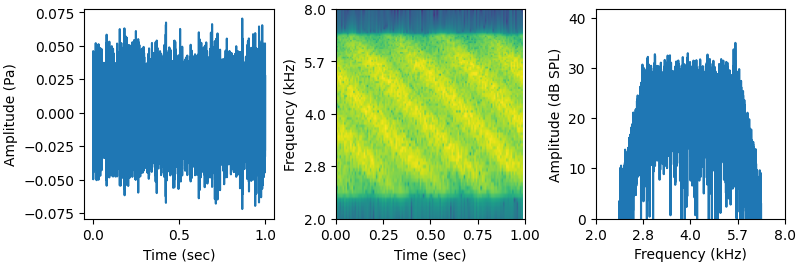
The AM and STM noise can both be generated using the stm function. The difference is in the cpo (cycles per octave) being set to 0 for modulations only in the time domain.
fs = 16000
Add a taper to the rolloff.
frequency = {
    'fc': 4e3,
    'octaves': 1,
    'rolloff_octaves': 0.25,
    'rolloff': 16,
}

w_stm = stim.stm(
    fs=fs,
    frequency=frequency,
    depth=9,
    duration=1,
    cpo=2,
    cps=4,
    mod_type='exp',
    calibration=FlatCalibration.from_spl(94),
    level=60,
)

w_am = stim.stm(
    fs=fs,
    frequency=frequency,
    depth=9,
    duration=1,
    cpo=0,
    cps=4,
    mod_type='exp',
    calibration=FlatCalibration.from_spl(94),
    level=60,
)

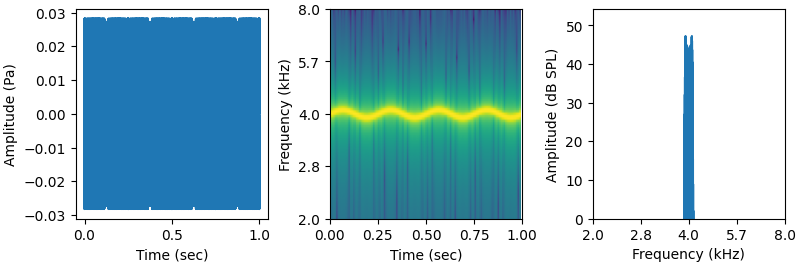
w_fm = stim.sfm(fs, 4e3, 4, 100, 1, 60, FlatCalibration.from_spl(94))

plot_waveform(w_fm, fs)
plot_waveform(w_am, fs)
plot_waveform(w_stm, fs)
plt.show()
Total running time of the script: (0 minutes 0.776 seconds)